Geneva | 2 October 2026
Minister of Human Rights, Mashdal Mohammed Omar, stated that the latest wave of escalation by the terrorist Houthi militias had resulted, according to preliminary figures as of 30 September, in the deaths of more than 250 civilians, injuries to more than 360 others, and the displacement of approximately 200,000 people. He held the militias responsible for the continued deterioration of the humanitarian and human rights situation in Yemen and the grave violations suffered by civilians, particularly children.
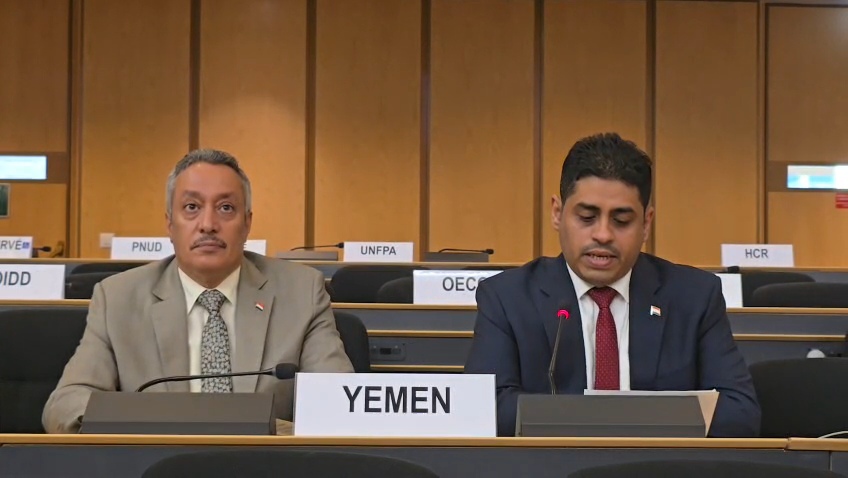
In the Republic of Yemen’s statement delivered by Minister Mashdal before the Human Rights Council at its 63rd session in Geneva today, Friday, he welcomed the report of the United Nations High Commissioner for Human Rights and reviewed the impact of the escalation on civilians, health and educational facilities, the continued recruitment of children, exploitation of migrants, detention of United Nations personnel and humanitarian workers, as well as threats to international navigation.
The Minister explained that the Ministry had obtained information about 50 people killed and injured as a result of the shelling of convoys of displaced persons fleeing from Hays to Al-Khawkhah, noting that the bodies of some victims had been burned and charred by the shelling. He also reviewed the killing of three children in a Houthi attack targeting the village of Al-Tarirah in Taiz Governorate on 17 September, including a girl no older than one and a half years, as well as the arrival of approximately 3,000 people in the Republic of Djibouti amid the continuing escalation and worsening humanitarian conditions.
He affirmed that the recruitment and use of children in armed conflict represents one of the most serious violations committed by the terrorist Houthi militias, which have turned schools, summer centers, and other civilian facilities into instruments of mobilization, indoctrination, and recruitment, and pushed children into a military environment that deprives them of education and protection and threatens their lives and futures. He pointed to the United Nations’ documentation of cases of child recruitment and their use in military and field roles by the Houthi militias.
He explained that the effects of the attacks had extended to health facilities and medical services in Taiz, Hodeidah, Marib, and the western coast, where services had been disrupted in 26 health facilities supported by UNICEF, undermining the ability of civilians, displaced persons, the wounded, and patients to obtain necessary healthcare. He also addressed the militias’ looting of warehouses, clinics, and medical facilities funded by the King Salman Humanitarian Aid and Relief Centre, and the targeting of the Saudi field hospital as part of the attacks that struck Al-Khawkhah, the Port of Mocha, and other civilian and service facilities.
In the education sector, the Minister explained that the escalation since 3 September had led to the closure or suspension of classes in 243 schools, affecting more than 140,000 male and female students, while classes had been suspended in 29 schools in Jabal Habashi District in Taiz Governorate, in conflict areas and nearby locations, just days after the start of the new academic year.
The Minister of Human Rights expressed the Yemeni government’s deep concern over the terrorist Houthi militias’ exploitation of African migrants through their recruitment, exploitation of their humanitarian circumstances, involvement in military activities, and coercion of some into combat areas under pressure and threats. He affirmed that these practices violate the rights and dignity of migrants and turn irregular migration into an additional source of insecurity and instability in Yemen and the region.
The Minister stressed that attacks on commercial vessels in the Red Sea and Bab al-Mandab have become a direct threat to freedom of navigation, international trade, the safety of seafarers, and global supply chains. He affirmed that turning maritime routes into an arena for military threats and extortion exacerbates the suffering of Yemenis, increases transportation and insurance costs, and affects the flow of goods and humanitarian assistance.
He also addressed the continued arbitrary detention of United Nations personnel and humanitarian and civilian workers, noting that the United Nations had confirmed last June that 73 of its staff members remained detained by the Houthi militias, that one of its staff members had died in detention, and that some were being held incommunicado.
At the conclusion of his statement, the Minister expressed the appreciation of the Government of the Republic of Yemen to the Human Rights Council and its Member States, looking forward to their support for and adoption of the draft resolution on the provision of technical assistance and capacity-building to Yemen in the field of human rights under Item 10, including the technical support it provides to the National Commission to Investigate Alleged Violations of Human Rights. He affirmed that this support represents an important contribution to strengthening national capacities, developing documentation and investigation mechanisms, and enhancing the protection of human rights in accordance with international standards.
He renewed the Republic of Yemen’s commitment to constructive cooperation with the Council and the Office of the United Nations High Commissioner for Human Rights, and to continuing efforts to protect civilians, safeguard the rights of children and migrants, and strengthen accountability, toward achieving peace based on the rule of law and respect for human rights.