Aden | 22 September 2026
Minister of Human Rights Mashdal Mohammed Omar said that the recruitment and use of children in armed conflict constitute one of the most serious violations facing Yemen’s children, affirming that child recruitment by the terrorist Houthi militias has become part of a broader systematic approach to exploiting the most vulnerable groups in society, foremost among them children, in order to achieve military and ideological objectives.
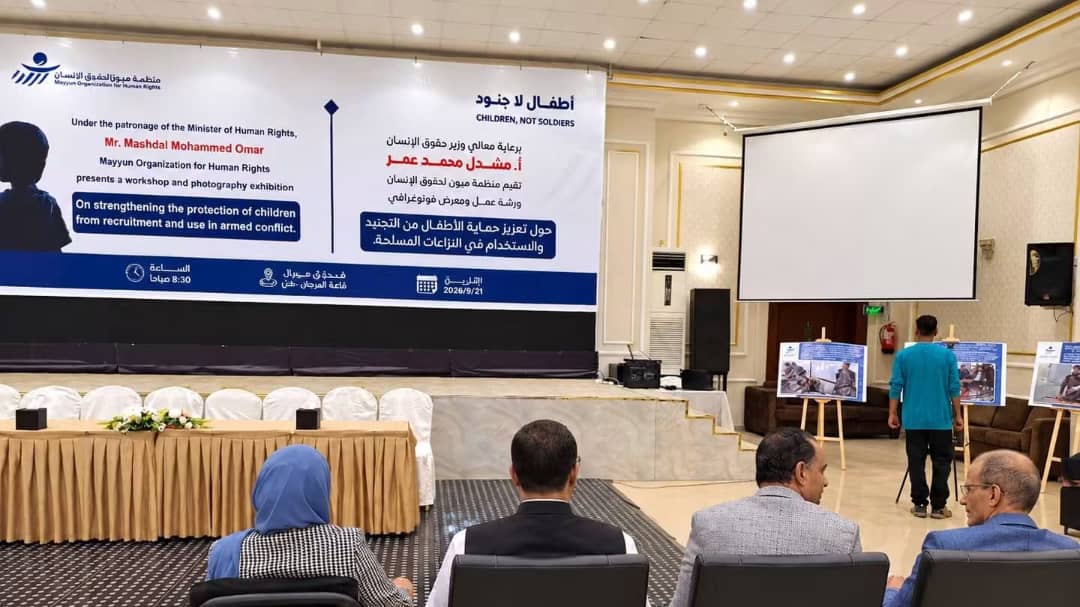
The Minister made the remarks in a speech delivered at the opening of a workshop organized by Mayyun for Human Rights under his patronage in the temporary capital, Aden, on strengthening the protection of children from recruitment and use in armed conflicts in Yemen, with the participation of a number of government officials, representatives of international and local organizations, and entities concerned with child protection and human rights.
The Minister of Human Rights explained that the gravity of this practice increases with the terrorist Houthi militia’s exploitation of poverty and need, its influence on children in schools and summer centers, and the pressure it exerts on families, in addition to the use of religious and ideological discourse to mobilize children and push them into military activities.
He noted that discussing child recruitment is not merely about numbers or an isolated violation, but rather about a child whose childhood is taken away, who is deprived of the right to education, protection, development, and safety, pushed into an environment he did not choose, and used in acts and operations that may put his life, safety, and future at risk.
Minister Mashdal affirmed that the recruitment and use of children in armed conflicts constitute a grave violation of children’s rights and may, depending on the circumstances and elements of each case, amount to crimes prohibited under international humanitarian law and international human rights law. He stressed that the effects of this crime do not end once the child is removed from the place of recruitment, but require protection, rehabilitation, psychological and social support, and ensuring the child’s safe return to his family, school, and community.
The Minister of Human Rights revealed that the number of children who have been recruited and killed in battles since 2015, according to available figures, has exceeded (4,700) children across various governorates. He explained that this figure represents the cases that could be documented and accessed, while the actual number is likely to be higher, in addition to children who remain recruited, or who reached adulthood after spending periods in camps and on battlefronts.
He affirmed that the Houthi militia bears, according to what he indicated, the primary responsibility for these figures, as the party that systematically and continuously recruits and uses children.
In his speech, he noted that the Ministry of Human Rights considers the issue of child recruitment to be one of its priority files, stressing the importance of strengthening cooperation among state institutions, civil society organizations, and international and United Nations organizations in the areas of monitoring, documentation, referral, response, prevention, accountability, and reintegration.
The Minister stressed that documenting cases should not stop at recording the incident, but should contribute to understanding recruitment mechanisms, identifying the children and groups most at risk, and the environments that allow this practice to continue, with a view to developing more effective means of prevention.
He called for the workshop to produce practical and implementable ideas and more effective mechanisms for coordination and information exchange, strengthen monitoring and documentation capacities, and establish clear indicators to measure the scale and trends of the phenomenon and determine priorities for intervention and prevention, alongside ensuring the protection of children rescued from recruitment and providing safe pathways for their rehabilitation and reintegration.
He further affirmed that addressing the phenomenon also requires working on the social, economic, and educational conditions that make some children more vulnerable to exploitation, calling on the international community to continue supporting national and local programs aimed at protecting children, strengthening the capacities of Yemeni institutions, and ensuring the continuity of monitoring, verification, and reporting mechanisms.
The Minister of Human Rights stressed that accountability does not conflict with child protection, but rather constitutes an essential part of it, affirming that no genuine progress can be made in preventing the recurrence of these crimes without working to hold those responsible accountable in accordance with the law and in a manner that guarantees the rights of victims.
Minister Mashdal commended the efforts of Mayyun for Human Rights in monitoring and documenting child recruitment in Yemen, praising the photographic exhibition accompanying the workshop, which documents part of the suffering of children who fell victim to this practice. He considered that turning documentation into visual material brings the suffering of children before the public and serves as a reminder that behind every documented case is a child with a name, a life, a family, and dreams of which he was deprived because of war, recruitment, and exploitation.
At the same time, he affirmed that the Ministry of Human Rights appreciates these efforts and supports their continuation and development in a manner that contributes to strengthening child protection, raising awareness of the gravity of the crime of child recruitment, and supporting prevention, accountability, rehabilitation, and reintegration efforts.
The Minister of Human Rights concluded his speech by stressing the importance of moving from monitoring the phenomenon to building a more effective response, from recording violations to preventing their occurrence, and from protecting children from recruitment to ensuring their right to a safe and dignified future.