Aden | 17 November 2026
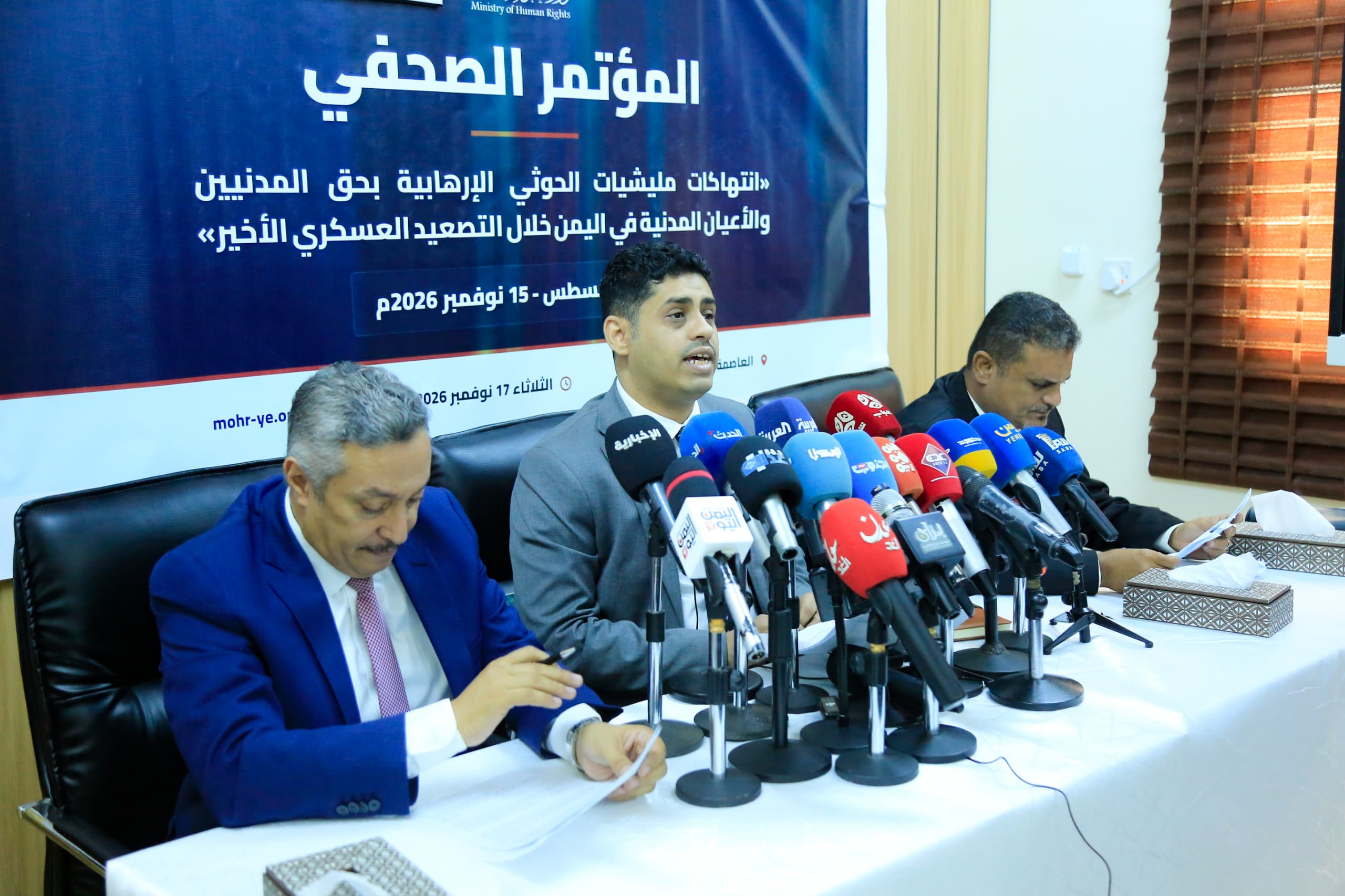
The Ministry of Human Rights issued a human rights briefing today, Tuesday, during a press conference held in the interim capital, Aden, on violations committed by the Iranian-backed terrorist Houthi militias against civilians and civilian objects in Yemen during the latest military escalation. The Ministry recorded 3,334 incidents of violations during the period from 1 August to 15 November 2026, based on monitoring and documentation activities carried out by its teams and data from approved sources.
Speakers at the press conference included Minister of Human Rights Mashdal Mohammed, Minister of State for Women’s Affairs Dr. Ahd Jassous, Deputy Minister of Human Rights Nabil Abdulhafeedh, and Director General of Complaints and Reports Imad Sinan. The conference was attended by Minister of Culture and Tourism Muti Dammaj, representatives of the National Commission to Investigate Alleged Violations of Human Rights, international organizations, civil society organizations, and local and international media outlets.
Human Casualties and Patterns of Violations
Minister of Human Rights Mashdal Mohammed presented the human casualty figures documented in the briefing, totaling 1,849 civilian casualties, including 594 killed and 1,255 injured. The casualties included 215 children, 196 women, and more than 80 elderly persons. The Ministry also recorded the killing of 127 persons in sniper attacks.
The briefing presented incidents of shelling targeting residential neighborhoods, villages, markets, and sites sheltering displaced persons, including Jaw Al-Naseem Camp in Marib, the Sinah neighborhood and Al-Hadharah Popular Market in Taiz, as well as displacement sites and educational and healthcare facilities in Lahj. The Ministry documented 53 attacks using ballistic and guided missiles, during which at least 121 missiles were launched. It also recorded the use of at least 137 attack and suicide drones. Ten incidents involving explosions of landmines or explosive devices resulted in 13 deaths and 16 injuries.
The briefing reported damage to 412 houses, residential buildings, and shelters, while 93 educational facilities were subjected to shelling, raids, unlawful use, or other forms of damage. Education was suspended in 243 schools, affecting more than 137,000 students. In the healthcare sector, the Ministry recorded 312 cases involving attacks and damage affecting healthcare facilities and centers, and 19 attacks on ambulances, including three cases of direct targeting and 16 cases of looting and confiscation.
The Ministry also documented 233 cases of abduction, arbitrary detention, and enforced disappearance, including 25 cases documented by name and 208 cases recorded as part of mass campaigns, affecting students, educators, activists, and humanitarian workers. The briefing reported the death of UN staff member Mohammed Ibrahim Al-Shami while in detention, which was announced on 31 October. The Ministry further documented the killing of 260 children who had been recruited by the militias and sent to the frontlines.
The Siege of Taiz and the Consequences of Displacement
Deputy Minister Nabil Abdulhafeedh addressed the tightening of the siege on Taiz city since the escalation of attacks in September and the disruption of vital roads, including the Taiz–Al-Kadhah–Mokha road and the Hayjat Al-Abd road connecting Taiz and Aden. The briefing explained that road closures and restrictions on movement through the remaining access routes had obstructed civilian movement and the delivery of food, drinking water, fuel, medicines, and humanitarian assistance. It also referred to the United Nations announcement on 2 November that all roads leading to the city had been closed due to fighting and that regular commercial supplies had ceased to arrive.
According to data from the International Organization for Migration cited in the briefing, more than 347,000 people were displaced as a result of the military escalation in western Yemen during the same period, with Taiz, Lahj, and Aden receiving the largest numbers. The briefing also referred to a warning by the United Nations High Commissioner for Refugees (UNHCR) concerning the approach of fighting toward Kharaz Refugee Camp in Lahj, which hosts approximately 9,000 refugees.
In her remarks, Minister of State for Women’s Affairs Dr. Ahd Jassous addressed the violations affecting women and the consequences of the escalation and displacement for their conditions. In this context, the briefing highlighted the increasing needs of displaced families for shelter, water, healthcare, and protection, and commended the resilience of Yemeni women and their efforts to cope with the conditions of war.
Legal Assessment and the Ministry’s Efforts
In its legal assessment, the Ministry concluded that the deliberate attacks it had documented against civilians amount to war crimes and that the documented incidents necessitate investigations by the competent national authorities to determine the responsibility of their perpetrators and the relevant commanders.
Director General of Complaints and Reports Imad Sinan reviewed field monitoring activities, the collection of testimonies, and the documentation of damage, including the visit to Al-Firdaws Camp for internally displaced persons in Aden and the field visit to Tur Al-Bahah District in Lahj. The briefing also presented the Ministry’s engagement with United Nations and European bodies. The Ministry reaffirmed its commitment to continuing the verification of incidents, preservation of evidence, and coordination with the competent national authorities to prepare legal case files, thereby supporting accountability for those responsible for violations and victims’ rights to justice and redress.